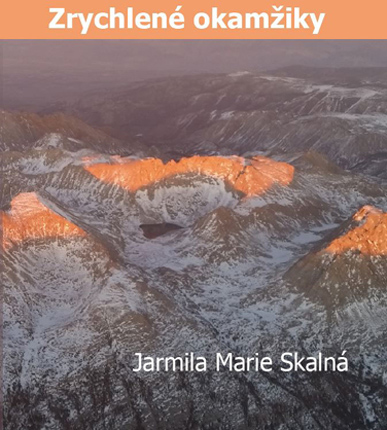
Ten short stories – ten compelling tales.
Each story has a unique narrative premise and a distinct energy. Some end on an optimistic note, others tragically—much as life itself unfolds. A sequence of singular events propels the characters into extraordinary life situations, and the author leaves it to them to navigate these circumstances. Through her imagination, she seeks to have her characters act in a human way—both toward one another and toward the world around them.
The author tells her stories with a lot of detail, which helps readers to have a greater visual imagination. At the same time, it leaves room for them to experience the entire story as intensely as possible while reading.
In the story "Mrs. Izabela," Olga looks forward to working for an American writer, but an unfortunate car accident thwarts her plans, causing her to lose an intriguing job that would have been truly meaningful for her abroad. In the story "Alone Across the Border," the courageous Sofie secretly crosses the border into Germany to join her beloved, who marries her immediately upon her arrival. How challenging will their journey through life together prove to be? In the story "Fearful Doubts," a young man discovers a girl who has hanged herself at the edge of a forest. Who is she? Why did she do it? Surely someone would have helped her had she only shared her troubles.
Skalná wishes that these formally calm short stories resonated with readers as strongly as they did with her when she wrote them.
A STRUGGLE FOR EPIC EXPRESSION
Czech exile literature is quite diverse; its final wave includes those who left for foreign lands in the 1980s. Among them is Jarmila Marie Skalná—a pseudonym for a prose writer originally from Lubojaty, near Bílovec. For her—and for the themes of her work—this "foreign land" became California and its surrounding region (a foreign land back then, but a partial home today). In her homeland, she studied at the Faculty of Education in Ostrava, specializing in Czech language and music education. To qualify for teaching at a higher level, she pursued the same field at the Faculty of Arts of Palacký University in Olomouc. She completed her state examination in Czech studies there, but before she could take the exam in music education, she emigrated to the United States in 1984. Her activities and experiences in America are reflected, in part, in her prose works.
Skalná's third prose work is called Jen zevsědnet bys nemela (You Shouldn't Be Ordinary) (1998) and begins like this: "It has stopped raining. The sun is high and warm. So warm. I watch the black birds as they join their wings and form a bridge in the sky so that the youngest daughter of the king and queen of heaven could meet the cowherd. If I could get to heaven on that bridge and choose what I would do there, I would want to be a gardener or go skiing. I stand on tiptoe. I observe a dewy leaf. I could paint your eyes on it with my finger every time you opened them wide. What am I thinking about now? How you promised me that you would walk with me around a meadow full of golden harmony." It is evident from this passage that Skalná is, by nature, a lyrical writer. Lyrical expression does not always sit easily with prose—a fact borne out by the author’s evolution toward an epic mode. Her journey toward the epic comprises two phases; the first consists of her initial two prose collections, published in quick succession: *Chodící hůlka* (1993) and *Modrý kovboj a žlutá kráva* (1994). In these texts, reality and the act of seeing shift—freely and often unexpectedly—into the realm of dreams, sometimes becoming quite bizarre: “A large bird circled in the sky. I watched its flight. It wasn’t aggressive; it was a happy bird. It let fall one feather, then two, then three, until I was completely covered and the bird itself was left bare. It took flight on the wind, but not a single feather followed it. The feathers lay still upon my body, keeping me warm. It began to rain, yet I remained dry. Only little streams flowed from my eyes when I closed them. Suddenly, I caught sight of my grandmother’s small figure, hunched over a grave, planting pansies and saying: ‘You must be cold, Grandpa.’ ‘It isn’t cold here, Maryčka.’” In the author’s texts, the real alternates with the dreamlike—the oneiric. The transitions from one sphere to the other are imperceptible, often leaving the reader struggling to find their bearings.
The author’s debut is somewhat more restrained in this regard—largely because it is a travelogue, a poetic journey in the footsteps of Ernest Hemingway. In fact, the full title of this first work is: *The Walking Stick, or A Smaller Great Journey in Search of Hemingway*.
The first two prose works are difficult to categorize in terms of genre. They contain a multitude of elements: they are lyrical prose, yet also memoir-like and diary-like, while at their core lies a tendency toward the short story, the novella, or even the novel. What was latent at the core during this initial phase found full expression and realization in the subsequent two prose works, which take the form of novellas. These are the aforementioned title *Jen zevšednět bys neměla* and the novella *Nora* (2013)—a title with an Ibsen-esque resonance.
The main characters are primarily young people; a notable exception is the older Gabriela from the first novella—one of the best characters Skalná has managed to create.
The adolescents in her novellas are verbally gifted; they talk too much and all too often take little action, which results in a certain static quality in the plot. Skalná, however, overcomes this through at least two significant structural devices. It remains a question whether she does so deliberately or if her intuitive grasp of the craft leads her to it; the fact remains, however, that both of these devices firmly establish these works as prominent examples of contemporary prose.
The first of these "tectonic" devices—so called because they pertain to the work of prose as a whole—is the *significant chapter*. In conventional prose, this role is often played by the thirteenth chapter, in which—while maintaining the narrative’s established logic and meaning—some misfortune (or a series of them) occurs; this is a convention found in the works of Leo Tolstoy, Henryk Sienkiewicz, and Oscar Wilde. In the *Nora* under discussion, Skalná assigns this significance to the eighth chapter. At the beginning of the novella, the protagonists, Nora and Vik, arrive at Slapy and select canoe number 8 from a rental shop: "Without prior consultation, they both chose the 'magical' eight—the eighth sign of the zodiac, a favorite of theirs. The young man who launched the boat for them reminded them that it should be returned by eight in the evening." While this may appear to be an inconsequential detail, the author elevates it into a pivotal tectonic device, manifested through this significant chapter. This significance manifests in four distinct ways:
(1) the protagonist, Nora, comes of age; (2) upon waking in the morning, she discovers a pendant—made of an unfamiliar dark-grey metal and bearing an engraved, mysterious symbol—around her neck; (3) the chapter contains a dreamlike sequence, the most extensive one in the entire novella; (4) Chapter 8 plays a key role in the overall structure of the narrative, as it is positioned exactly at the one-third mark (the novella consists of 24 chapters). For Skalná, then, a "significant" chapter is a fortunate one, yet one also imbued with a sense of mystery. It should be added that the author does not neglect the more traditional conception of a significant chapter; Chapter 13 features a scene in which the abstemious Nora—who normally shuns alcohol—gets drunk for the first time in her life.
Beyond a significant chapter, the structure of the novella is also held together by the enigmatic figure of Quisto, whose views profoundly influence Nora’s existence. Quisto is mysterious precisely because he never enters the narrative stage; he is a meta-diegetic character. While he seemingly does not exist, he simultaneously provides the protagonist with vital energy. Indeed, the Latin *quis* translates to "who," "what," "which," "what kind of," "someone," or "anyone." Furthermore, this mysterious figure corresponds to a cryptic pendant that Nora discovers around her neck on the day she reaches adulthood. While the origin of the pendant is explained in the final chapter, the meta-diegetic character remains an enigma throughout.
Vik, Nora’s cousin, points out to his friend how Mike Oldfield, in his composition *Amarok*, used Morse code to tap out a harsh "Fuck off" to his producer. He did so covertly—subliminally, intended only for those on the inside—much as Skalná does in *Nora* through a significant chapter and a meta-fictional character, likewise revealing it only to a select few. Unlike the English guitarist, however, she—as a woman—approached it with greater elegance.
Jarmila Marie Skalná is also a bilingual author; she published two prose books in English in the United States: *Striding into the Sun* (2005) and *Who Needs Dreams?* (2007). Once again, those dreams that haunt the people who carry them.
Other prose works by Skalná—for instance, the short stories *Bára* and *Paní Izabela*—reveal a great deal about the author. Above all, they show that she draws upon her own experiences within the American environment, and furthermore, that she maintains a consistent interest in female characters—a focus in which she particularly excels. Moreover, they confirm her inclination toward epic narrative—toward an epic perception of the world around her, a world that is at times even mysterious.
František Všetička
[PhDr. František Všetička, CSc. is a literary historian and scholar, literary theorist, writer and translator.]